Real-time crypto market intelligence, right in your terminal.
HyperData Terminal streams public WebSocket feeds from Hyperliquid, Binance, Bybit, OKX and Deribit into six live dashboards, a local REST API and a paper-trading engine. Open source under Apache-2.0. No API keys to get started.
- Exchanges
- 5
- Dashboards
- 6
- Data components
- 14
- API endpoints
- 17+
- License
- Apache-2.0
- Runtime
- Python 3.12+
Six dashboards. One command.
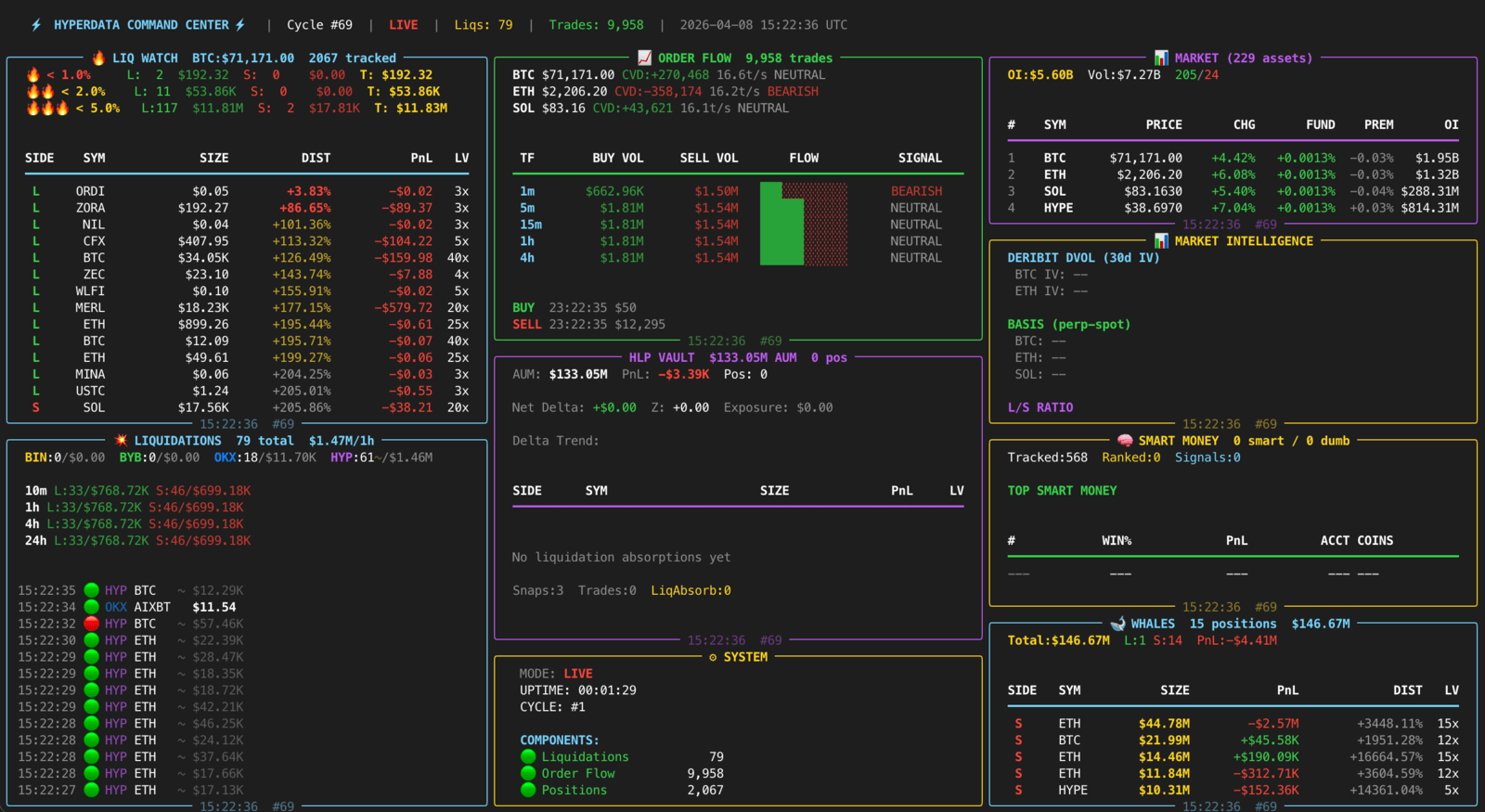
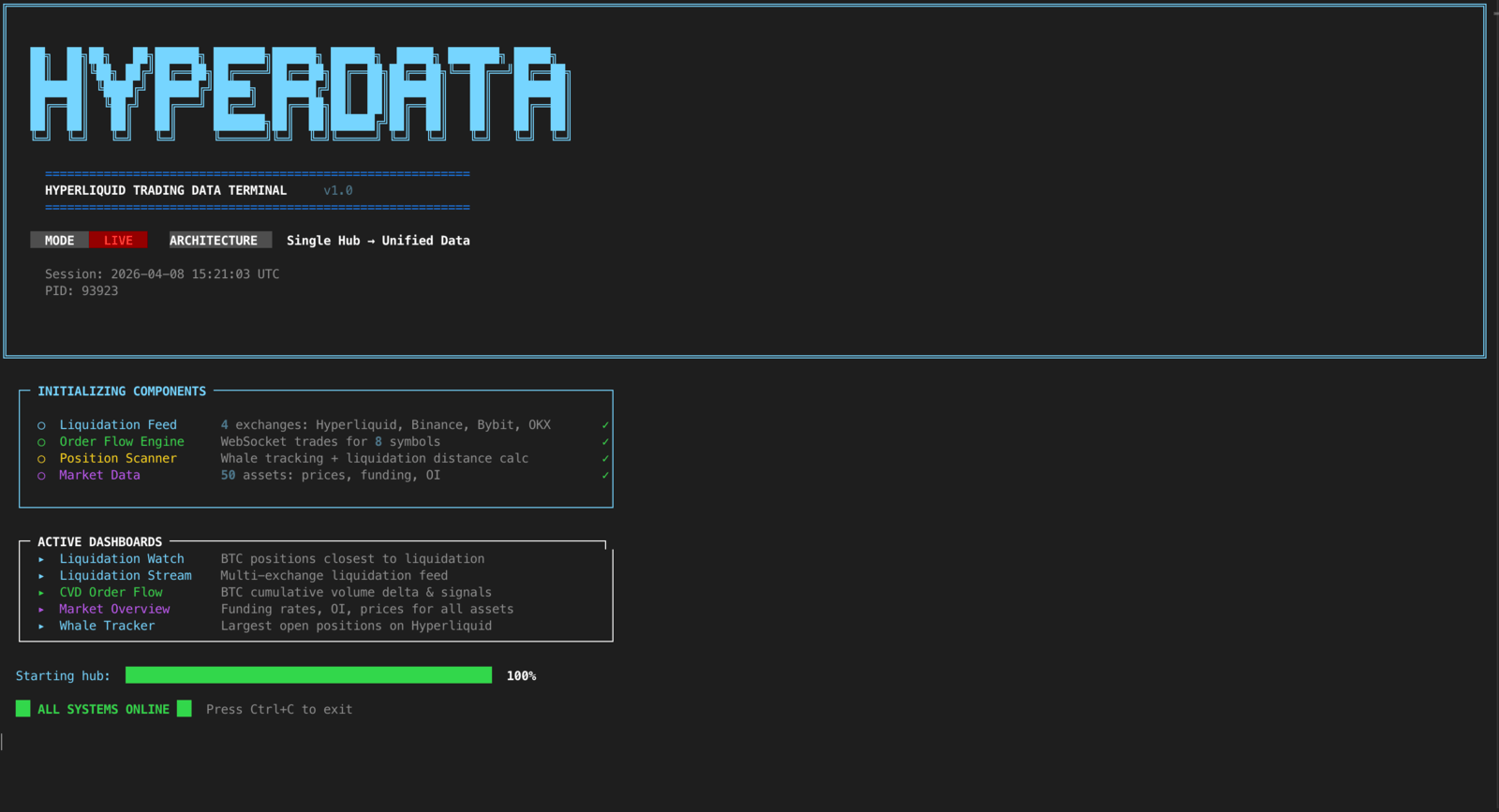
Run hyperdata and pick a view from the menu. Every dashboard reads from the same data hub and updates in real time.
| Key | Dashboard | Shows | Source |
|---|---|---|---|
| [1] | Liquidation Watch | BTC positions closest to liquidation on Hyperliquid. Distance-to-liquidation is tracked in real time, so you can see which whales are about to get wiped. | Hyperliquid |
| [2] | Liquidation Stream | Multi-exchange liquidation feed from Hyperliquid, Binance, Bybit and OKX, with size, price and exchange for every event. | 4 exchanges |
| [3] | Liquidation Heatmap | Price-level view of where liquidations are concentrated for all cryptos: long-liquidation risk below price, short-liquidation risk above it. | 4 exchanges |
| [4] | CVD Order Flow | Cumulative volume delta for BTC, combined from Hyperliquid and Binance trades, with each venue's share shown separately. See whether buyers or sellers are in control. | Hyperliquid + Binance |
| [5] | Market Overview | Funding rates, open interest and prices for 50 assets across exchanges. Spot divergences and funding extremes at a glance. | Cross-exchange |
| [6] | Whale Tracker | The largest open positions on Hyperliquid: size, entry price, PnL and liquidation price for the biggest players. | Hyperliquid |
| [0] | All Dashboards | The combined view, everything at once. | All |
Five exchanges. Public feeds. No keys.
All data is fetched live from public exchange endpoints over WebSocket and REST. Nothing to sign up for, nothing to configure before the first run.
Inside, one hub owns 14 data components and manages their async lifecycles. The dashboards, the API and the paper-trading engine all read from that same hub, with no duplication.
- Liquidations from 4 exchangesHyperliquid, Binance, Bybit, OKX
- CVD order flowHyperliquid + Binance trades
- Whale positionsHyperliquid
- Funding ratesby exchange
- Open interest50 assets
- Orderbook depthBinance
- DVOL implied volatilityDeribit
- Long/short ratios
- Spot prices
- Smart-money signals
Ten of the fourteen components, as listed in the project README.
| Source | Data | Connection |
|---|---|---|
| Hyperliquid | Trades, positions, liquidations, funding, whale tracking | WebSocket + REST |
| Binance | Trades, liquidations, orderbook | WebSocket |
| Bybit | Liquidations | WebSocket |
| OKX | Liquidations | WebSocket |
| Deribit | DVOL implied volatility | REST |
Build on the same hub.
Everything the dashboards see is available to your own code: through a local REST API and WebSocket, or directly inside a paper-trading strategy.
REST API and WebSocket
Start the server alongside or instead of the terminal. It binds to 127.0.0.1 by default and refuses a public bind unless you set an API key or explicitly accept the risk.
$ python run_api.py --port 8420

$ curl http://localhost:8420/v1/market/BTC | python -m json.tool
$ curl http://localhost:8420/v1/orderflow/BTC
$ curl http://localhost:8420/v1/liquidations/stats
$ curl http://localhost:8420/v1/positions/danger-zone
All 17 endpoints
| Endpoint | Returns |
|---|---|
| GET /v1/live | Minimal liveness probe, always unauthenticated |
| GET /v1/health | Server status and uptime |
| GET /v1/market | All assets: prices, OI, funding |
| GET /v1/market/{symbol} | Single asset detail |
| GET /v1/liquidations | Recent liquidation events |
| GET /v1/liquidations/stats | Aggregate liquidation statistics |
| GET /v1/orderflow/{symbol} | CVD snapshots for a symbol |
| GET /v1/funding-rates | Funding rates across exchanges |
| GET /v1/funding-rates/{symbol} | Single asset funding rate |
| GET /v1/long-short-ratio | Long/short ratio |
| GET /v1/basis | Basis spread |
| GET /v1/deribit/iv | DVOL implied volatility |
| GET /v1/orderbook/{symbol} | Orderbook snapshot |
| GET /v1/whales | Top whale positions |
| GET /v1/positions/danger-zone | Positions closest to liquidation |
| GET /v1/public/metrics | Server metrics and component health |
| WS /v1/ws | Real-time event stream: liquidations, trades, signals |
Optional LLM agent
The agent sends a market summary to any OpenAI-compatible API and asks for a trading decision. Point it at OpenAI, Ollama, LM Studio, Groq, Together or your own endpoint with three variables in .env: LLM_BASE_URL, LLM_MODEL and LLM_API_KEY. The prompt lives in src/strategies/llm_agent.py.
Paper trading, your strategy
Real market data, fake money. A strategy is one class with one method that returns a signal or nothing. The whole interface fits in about 30 lines.
from src.strategies.base import Strategy, Signal

class MyStrategy(Strategy):
    name = "my_strategy"

    def evaluate(self, hub) -> Signal | None:
        # hub.orderflow, hub.market, hub.liquidations,
        # hub.funding, hub.lsr, hub.positions,
        # hub.spot, hub.deribit are all live here.
        snap = hub.orderflow.get_snapshot("BTC", "5m")
        if not snap:
            return None

        cvd = snap.buy_volume - snap.sell_volume
        if cvd > 100_000:
            return Signal("BTC", "BUY", size_usd=100,
                          confidence=0.7,
                          reason="Strong buy pressure")
        elif cvd < -100_000:
            return Signal("BTC", "SELL", size_usd=100,
                          confidence=0.7,
                          reason="Strong sell pressure")
        return None
Included example strategies
| Strategy | Reads | Logic |
|---|---|---|
| CVDMomentum | hub.orderflow | Buy when order flow is strongly positive, sell when negative |
| FundingRateArb | hub.funding | Short when funding is high, long when negative |
| LiquidationCascade | hub.liquidations | Buy the dip after large liquidation cascades |
| WhaleFollow | hub.positions | Mirror the direction of the largest whale positions |
Data that checks itself.
The hub continuously cross-checks its live feeds against Binance and Deribit and flags anything stale or drifting. The state is printed on the dashboard and exposed at /v1/health, so your own tools can read it too.
Coverage is honest, not a complete census. OKX and Bybit liquidations are real feeds, with Bybit covering its top 15 symbols. Binance's stream is throttled at the source to about one liquidation per symbol per second. Hyperliquid liquidations are inferred from large trades and flagged as estimated. Details are in docs/DATA_INTEGRITY.md.
| State | Meaning |
|---|---|
| LIVE | The feed agrees with the reference. Data is arriving and matches the cross-check within tolerance. |
| STALE | The feed has gone quiet. No fresh data has arrived recently, so what you see may be out of date. |
| DRIFT | The feed disagrees with the reference. Values have diverged from Binance or Deribit beyond the expected range. |
Four commands to live data.
Clone, install, run. The first launch opens the dashboard menu with data streaming from all five exchanges.
- Requires
- Python 3.12 or newer, pip, git
- API keys
- None for the dashboards or the API. Only the optional LLM agent needs one.
- License
- Apache-2.0
$ git clone https://github.com/Co-Messi/HyperData-Terminal.git
$ cd HyperData-Terminal
$ pip install -e .
$ hyperdata